











Building Is No Longer the Hard Part: How Data and FP&A Teams Should Work in the AI Era
It’s 11pm on a Tuesday and a middle-market CFO is finishing a Claude-backed report before a management presentation first thing in the morning. She’s the only one who knows exactly what it should say, so she’s the one building it. She rebuilds it from scratch every month, pieces it together from ten different exports, and emails it around so others can see it. Next month, she’ll do it all again.
We see versions of this everywhere. Operations managers stitch mountains of Excel spreadsheets into beautiful reports that contain incorrect metrics on closer inspection. Financial analysts publish apps full of sensitive data without proper security. Plant managers can’t take Mondays off because they manually build then email a report to a self-managed 113-person distribution list.
These people are incredibly resourceful, creating data products that were impossible a few years ago. AI has fixed some of the issues, but the root cause of the problem still remains. The operating model needs to change in the AI era.
In our previous article we argued that the foundation is a single, governed set of data definitions. Here we describe how to effectively build on it. The companies getting it right do five things:
- They use the value-creation plan to decide what not to build.
- They emphasize prototyping over lengthy requirements documentation.
- They have the data team turn prototypes into products.
- They exercise strong judgment, validating before, during, and after release.
- They change processes instead of just building tools.
Here’s what it looks like:
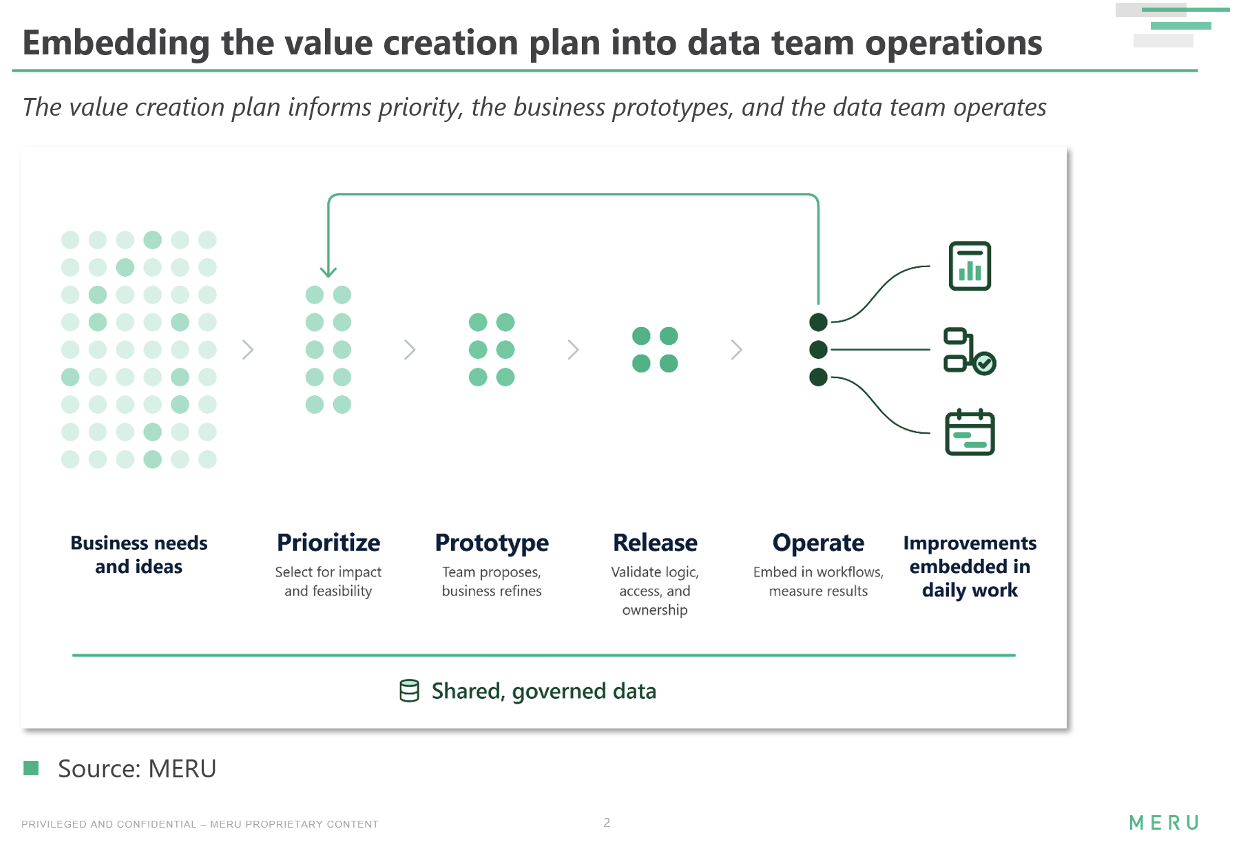
1. Use the value-creation plan to decide what not to build
The danger today is building too much. When AI can turn any idea into reality, businesses can quickly end up with a sprawl of unused reports and conflicting numbers.
The first piece of any AI-enabled operating model is a ranked list of reports, applications, and workflows tied to the value-creation plan. Each should be ranked by its effect on revenue, margin, and productivity; how hard it is to build; and whether people will use it.
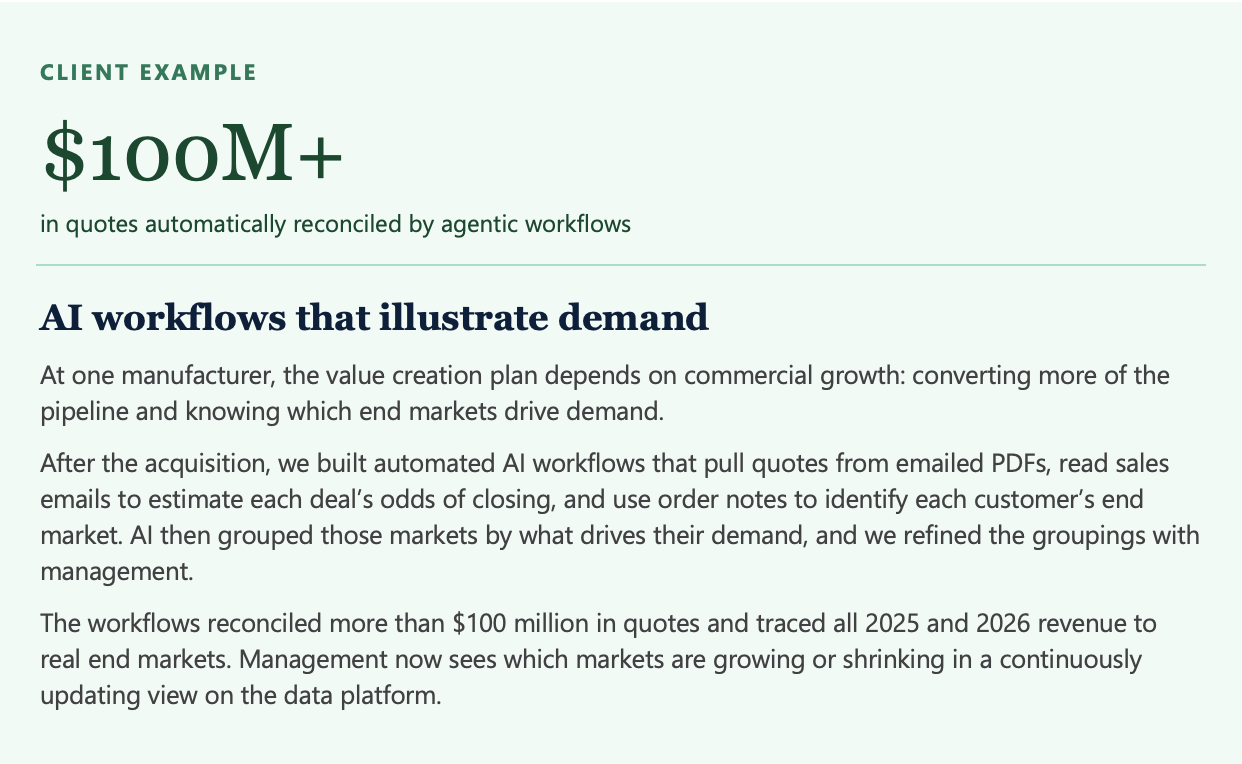
Ranked this way, the backlog favors custom tools that act directly on the plan. Trusted data and reporting is table stakes, but as AI lowers the effort required to build applications and automated workflows, the data platform can also run parts of the business, not just report on it.
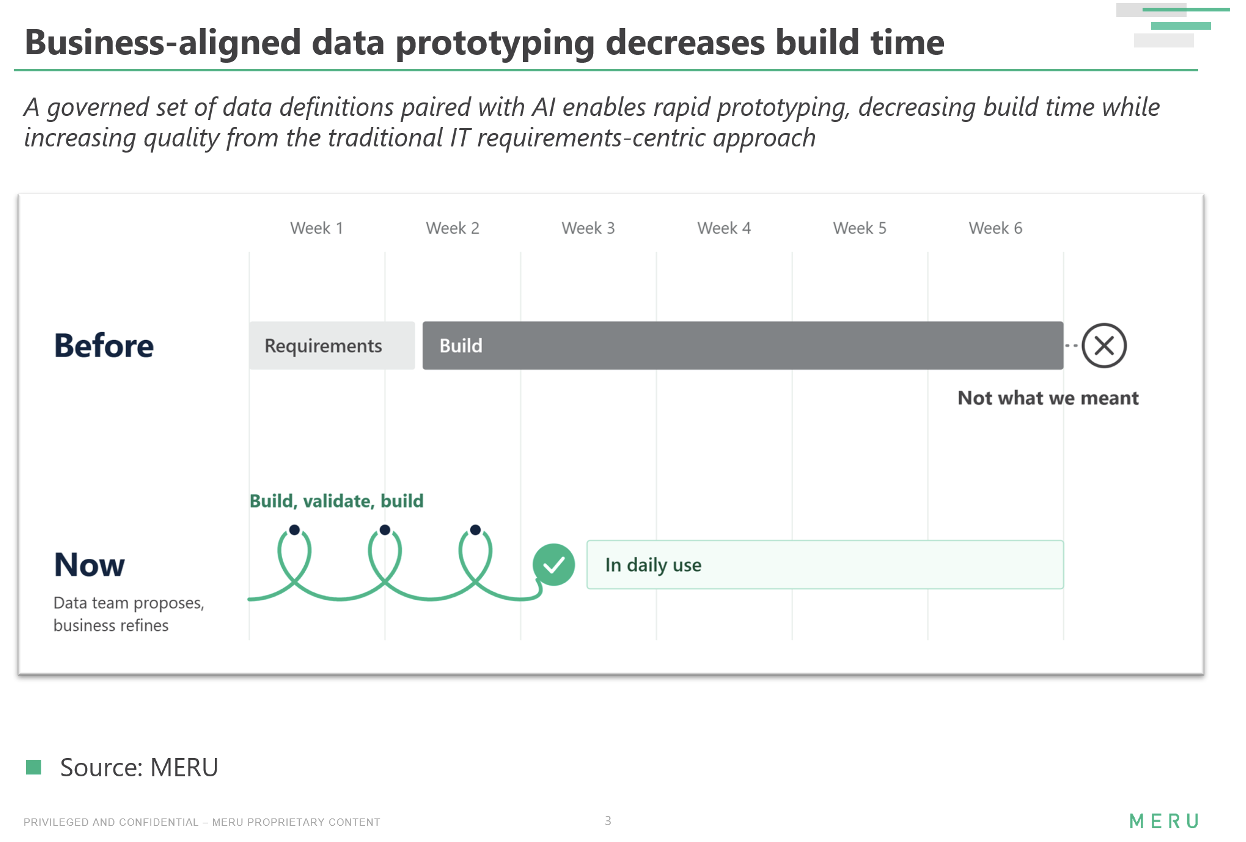
2. Emphasize prototyping over lengthy requirements documentation
In the new model, leaders often stay close to the build. They frame the business problem, then either sketch the first version themselves or shape it with the data team in quick working sessions. Because AI makes building so fast, these sessions often end with a working prototype.
Everyone else is building too. As operators throughout the organization quickly build AI-generated products, leaders need to be comfortable reacting to rough and incomplete work rather than waiting for polished results. Feedback and validation early and often are key as a wider range of people are able to prototype.
Where the supporting infrastructure and clearly defined metrics are already in place, we have seen the average time to build a report decrease by 50+%.
3. Have the data team turn prototypes into products
Once a leader hands off a prototype, the data experts move it onto governed data, tie out the numbers, lock down access, and assign an owner, often rebuilding parts of it along the way.
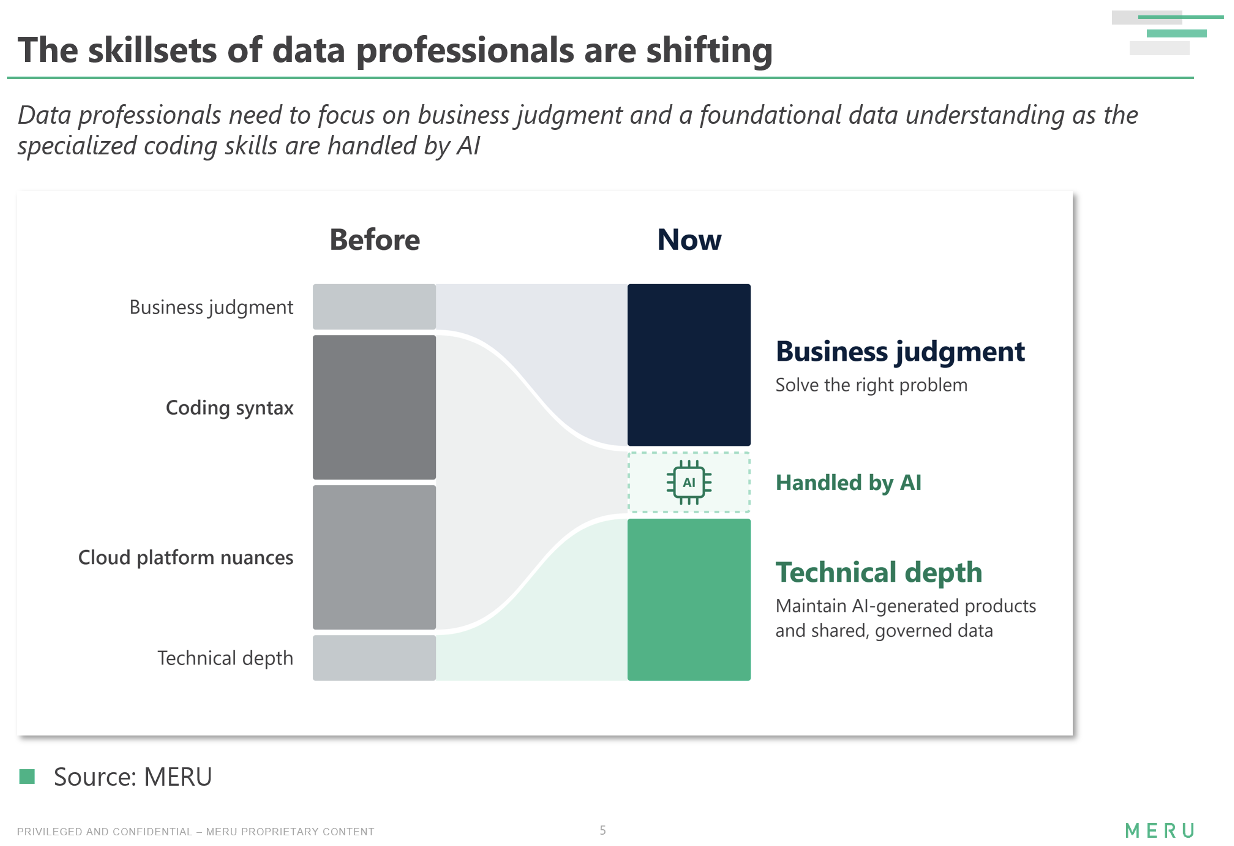
The job of the traditional report developer changes. Data and FP&A teams that define themselves by building will be overtaken by their own business users. Their value now lies in judgment, curation, and making things trustworthy, which makes them even more important.
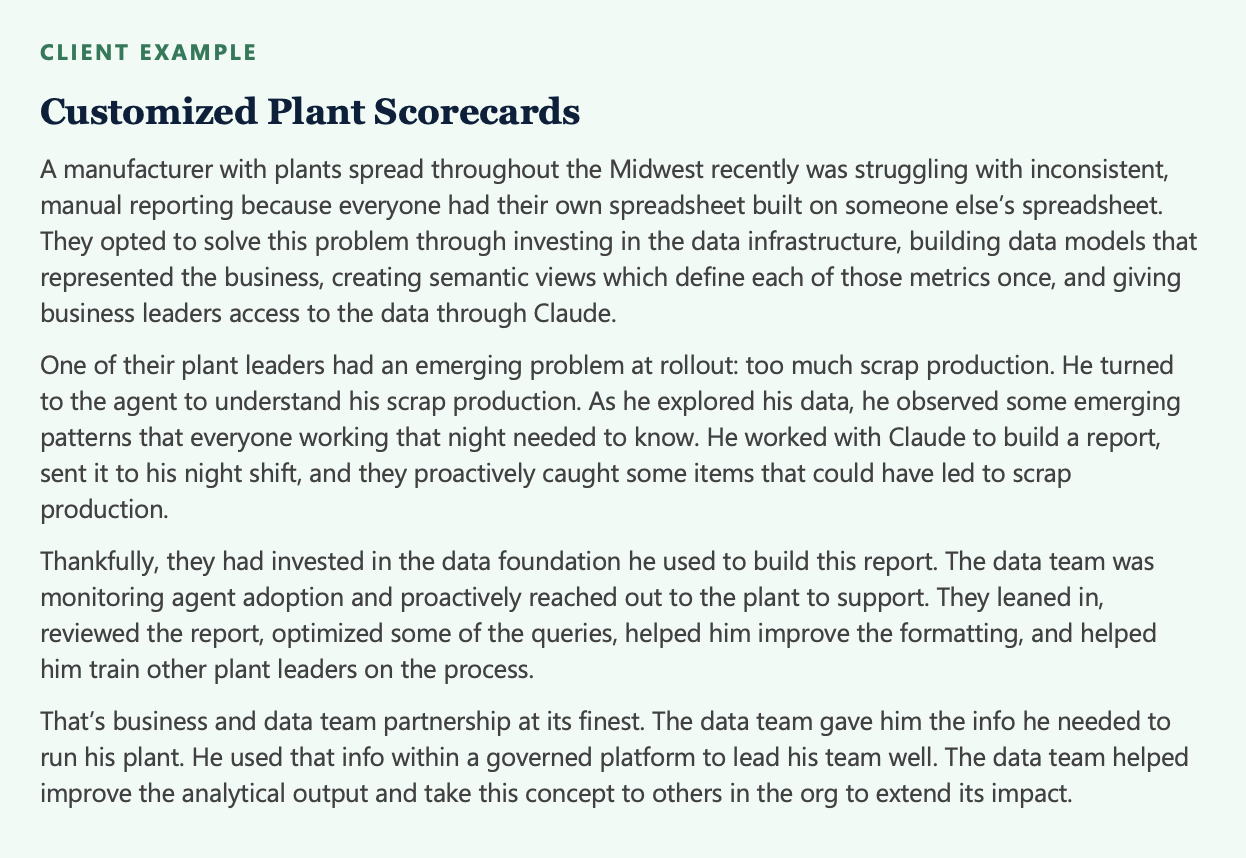
On the business side, the data experts must be consultative and product-oriented: investigating problems, forming a point of view, and bringing concrete recommendations for leadership to challenge. This prevents leaders from becoming a bottleneck responsible for diagnosing every problem and designing every solution.
On the technical side, the data experts should be spending more time on the foundations everyone else builds on: curating shared data models, building applications, writing evaluation frameworks, automating workflows with agents and maintaining the platform.
AI now handles much of the coding that once set data professionals apart. What’s scarce is business judgment to pick the right problem, and the technical depth to maintain AI-generated products and the shared set of governed data.
4. Exercise strong judgement, validating before, during, and after release
Validation is where AI delivery frequently falls short. It is easy to have Claude build a dashboard, but it requires strong judgment to validate what is built for both accuracy and business alignment.
On the business side, stakeholders must buy into the alignment need. If multiple definitions exist for a metric (e.g., two “pipeline” numbers) or a definition is incorrect (e.g., it incorrectly excludes A100 product codes), they are responsible for flagging the misalignment and working with their data experts to resolve for the organization. Reverting to old patterns and building a one-off spreadsheet to fix these issues will leave a wake of confusion, misalignment, and poor decisions.
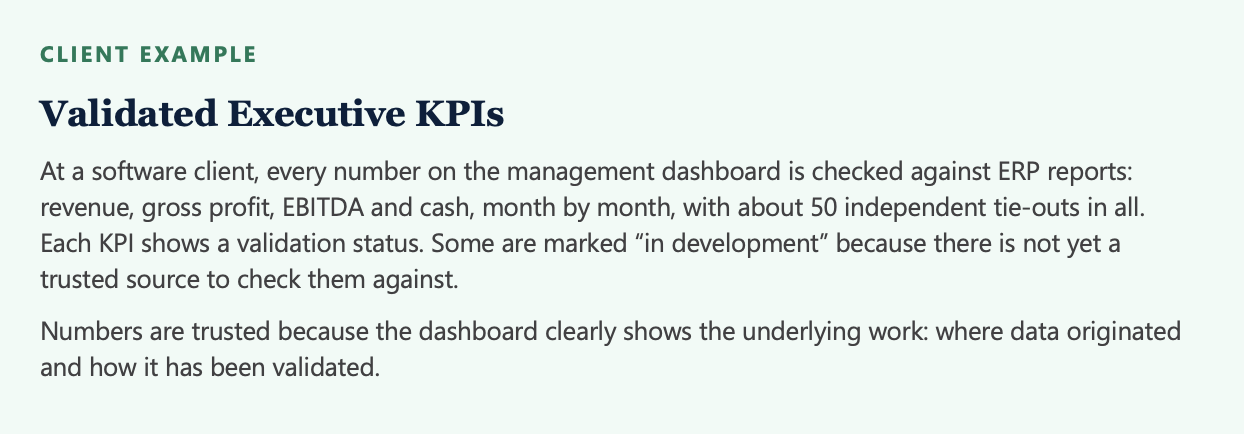
On the technical side, the data experts should embrace an automated validation methodology that is clearly surfaced within reporting. We’ve found that clearly laying out any tie-outs in the reports themselves help to increase confidence in AI-generated reporting.
5. Change processes instead of just building tools
With the increased build velocity, organizations have the potential to get overwhelmed as new features come faster than they can validate and absorb the change.
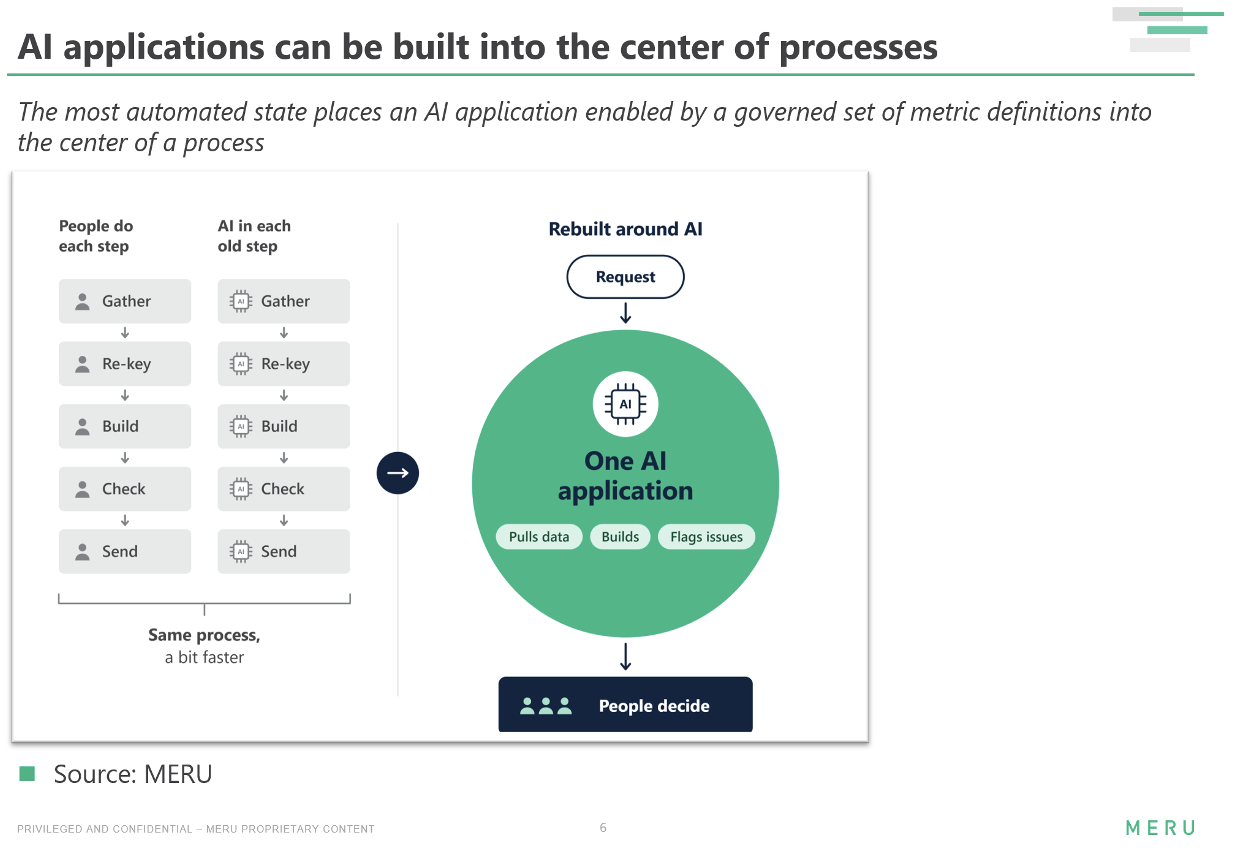
The data and FP&A teams getting it right embrace a process improvement mentality over a build mentality. They understand that the goal was never a pretty dashboard, a new MDM tool, or an automated pipeline. Tools built quickly can still fail as they always have — being discarded as people fall back on the manual process they know.
The best results come when the process is rebuilt with the new way of working in mind. In some instances, this means that you put an automated application or workflow at its center (see graphic). In other instances, this means adjusting how a sales team enters data to begin with. It can also mean a new operating rhythm more closely aligned with KPIs needs to be implemented.
The common supporting thread is a data and FP&A team that builds a strong, validated foundation and partners with the business to use it to drive change. They are never building a tool and dropping it off.
Putting it all together
Back to that CFO at 11pm on a Tuesday. She built something useful, but it couldn’t run without her.
In the new operating model, her first version begins the development lifecycle. She frames the problem and sketches the report. The data and FP&A team moves it onto governed data, ties out the numbers, and changes the monthly process around it. Next month the report is already there, freeing up her Tuesday night.
None of this works without the foundation from our previous article: one governed set of definitions that everyone builds on. With that in place, middle-market companies can use AI to build faster and still trust what they build. Building is no longer the hard part. The companies that win will be the ones that decide what to build, validate it, and change how the business runs because of it.
Click here to learn more about how MERU can help your organization harness the full potential of your data. Our team of experts is ready to partner with you to design and implement a data strategy that meets your specific needs.
Authored by: Mike Rasmussen, Solutions Architect; Preston Howell, Senior Principal