











Why "incremental improvement" won't change your Company's trajectory, and when a true step-change is required.
“Transformation” has become one of the most overused, and misunderstood, words in business. Most transformations fail not because the ideas are wrong, but because leaders never change the systems required to support them or fail to secure the company-wide buy-in needed on the need to change. Here’s when a transformation is actually necessary, and how to get it right.
What do we actually mean by "transformation"?
The word “transformation” gets thrown around as a catch-all solution to Company performance issues, often triggering skepticism from executives. At MERU, we’re deliberate about how we use it.
We define a company transformation as:
"A wide-scale, focused effort to identify and implement value-creating initiatives with urgency - representing a true step-change from how the business operates today."
A transformation is not a series of incremental improvements. It is a company-wide commitment to doing things differently.
As John Kotter’s research highlights, transformations fail when leaders ask teams to behave differently - but continue to reward them for behaving the same. Without changing incentives, decision rights, and the operating cadence, organizations revert to old habits.
When is a transformation necessary?
Like individuals, organizations drift into habits. The status quo becomes comfortable, even when it quietly leaves value on the table. A transformation creates a forcing function to reassess everything with fresh eyes.
Today, we see transformations launched for six primary reasons:
1. Jumpstart performance. Even successful companies stall and get comfortable. A regional grocer, who could have been comfortable as the market leader, used a transformation to ‘think bigger.’ They streamlined store operations, reduced COGS, and invested that value in launching new digital and urban formats - driving both margin expansion and new revenue. This ultimately helped protect them from competitor threats that came a year later
2. Address issues before it's too late. Early warning signs of future revenue or profit challenges are often rationalized away. A creative media company was growing in revenue but had declining profitability. They chose to act early and address the underlying issues instead of accepting the trade-off of growth and margin. Now, they are on track to improve margins by 200 basis points
3. Reset a broken business model. Persistent underperformance usually signals misalignment across the business. A struggling life sciences company restructured its product portfolio to better align with a renewed GTM strategy, improving EBITDA by 15% while stabilizing revenue
4. Create momentum after a pivotal change. Acquisitions and leadership transitions are ideal moments to accelerate value creation. After a couple years, a large apparel retailer had not achieved the expected value from the original thesis. It launched a three-phase transformation that improved EBITDA by $200M and changed the trajectory of the business
5. Build leverage in a negotiation. A credible transformation plan can be a powerful alternative during a sale process. One PE-backed tech company, in reaction to an initial set of underwhelming bids, created a transformation plan in four weeks and leveraged that to justify a higher valuation - ultimately increasing a bid by 50%
6. Capture unrealized M&A value. Synergies often underdeliver post-merger. Uncertain of the underlying reasons behind falling short of synergy targets, a Waste & Recycling company used a transformation to unlock a 10% EBITDA increase in six months, which was double the initial goal
How to get started?
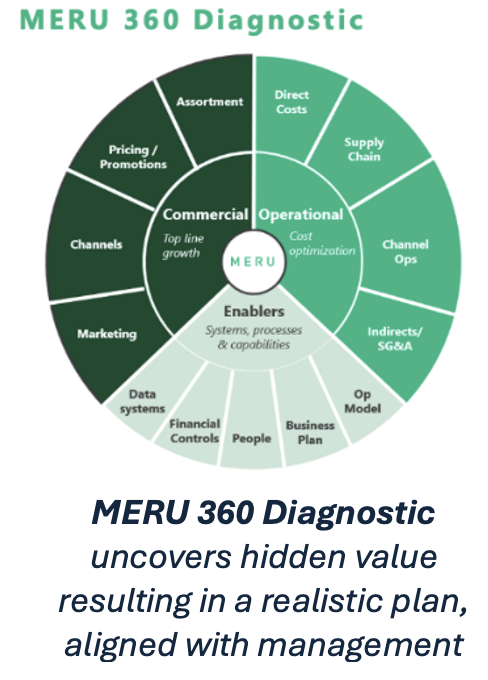
Successful transformations begin with a focused Diagnostic that is both expansive and aligned with management in its focus on uncovering a Company’s full potential.
Everything is on the table. Start with leaving no stone unturned; then prioritize opportunities by impact and feasibility to effectively deploy resources. In our experience, “sacred cows” come up early and often during such conversations, and rigorous debate can surface hidden mindsets and beliefs that implicitly protected the organization from change.
Leadership alignment is critical. This is not an ‘outside-in’ or theoretical exercise. The plan must be co-created with the executive team who will commit and own its execution. This can occur as quickly as four weeks - and often re-energizes teams that have felt stuck.
Where do most transformations fail?
Execution.
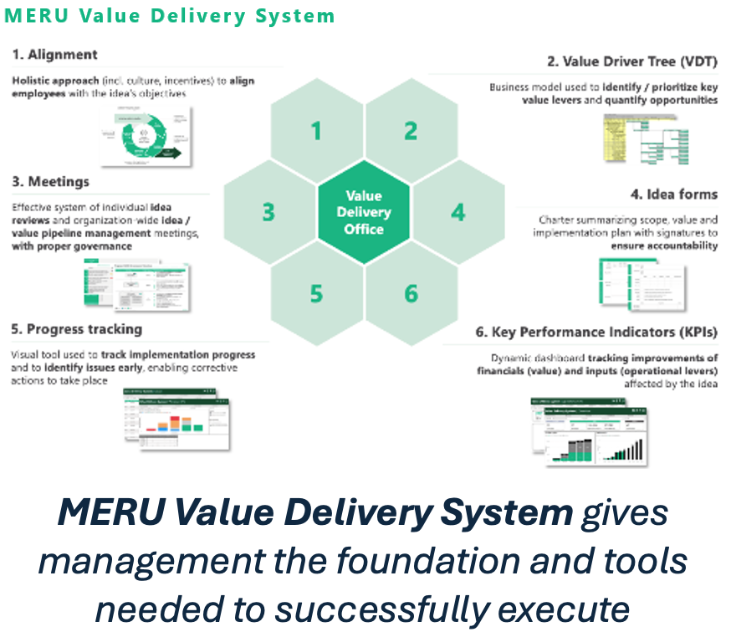
Without changing the environment in which people operate, organizations revert to old habits. What’s required is to create a Value Delivery System: clear targets, disciplined cadence, accountability, and shared ownership that sustains results over time. Simultaneously, companies must secure widescale buy-in from their employees to make sure the change sticks.
How MERU helps
Companies partner with MERU for the same reason individuals hire personal trainers: expertise, structure, and accountability.
We work alongside management teams to identify value levers, design initiatives grounded in real operating experience, and build the systems and incentives required to deliver and sustain results. And our incentives are aligned with outcomes - when our clients succeed, we succeed.
Final thought
A well-run transformation can align your people behind a new vision and fundamentally change your company’s trajectory.
At MERU, we specialize in helping middle-market companies turn ambition into measurable, bottom-line results.
Learn more about our services here.